


The easiest leads are the ones you never had to convince.
Let me say something that makes a lot of “marketing experts” uncomfortable.
Most businesses do not have a lead problem.
They have a trust problem.
And referrals are what trust looks like in the real world.
If you run a service business, a local shop, a medical office, a law firm, an agency, or anything where reputation matters, referral marketing can be the highest ROI thing you do all year.
Not because it’s trendy. Because it’s human nature.
Nielsen reported that 88% of people trust recommendations from people they know more than any other channel.
So if you want growth without constantly paying more for clicks, referral marketing is where you win.
This guide is the full playbook.
Stage 1: What a referral is
A referral is when a person (or business) sends someone to you with trust already attached.
That trust can come from:
-
a friend, family member, or coworker
-
a neighbor in a local Facebook group
-
a contractor buddy on a jobsite
-
a client who already likes you
-
another business that serves the same customers (a “partner referral”)
A referral is not “someone clicked your ad.”
A referral is “someone already believes you are the right move.”
That is why referral marketing tends to convert better.
Wharton research on referred customers (banking study) found referred customers had higher lifetime value and were more likely to stay compared to non-referred customers.
Stage 2: The numbers that make referral marketing a no-brainer
Here are the two stats every business owner should keep in their head:
1) Trust is lopsided
People overwhelmingly trust people they know. That’s the referral advantage.
2) Word of mouth is massive money
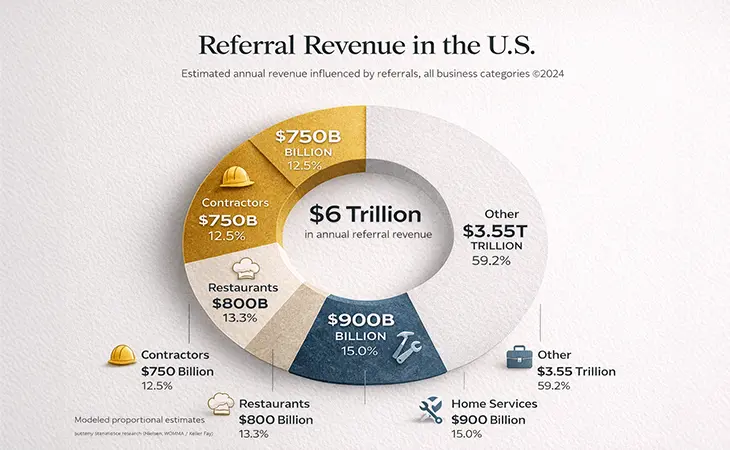
A WOMMA / Keller Fay study (widely reported) estimated word of mouth influences 13% of consumer sales, reported as about $6 trillion annually in the U.S.
Important note: that $6T is not “cash paid out through referral programs.” It’s sales influenced by recommendations (offline + online). That’s still the point: referrals and word of mouth are a serious economic engine.
Stage 3: Why referrals drive different businesses differently
Referral marketing isn’t one-size-fits-all. The “why” changes based on what you sell.
Service businesses (contractors, home services, repairs)
-
Customers feel risk: “Will they show up? Will they overcharge me?”
-
Referrals reduce that fear fast.
-
One happy customer can create a chain (neighbors, HOA, family).
Professional services (law, accounting, medical, insurance)
-
Customers feel uncertainty: “Is this person legit?”
-
Referrals act like pre-approval.
Restaurants and local shops
-
Customers want social proof: “Is it good?”
-
Referrals spread through group chats and local communities.
B2B and agencies
-
Customers are protecting their job.
-
A referral gives them cover: “This is who my colleague used.”
This connects directly to what we talk about in How Customer Trust Is Built Before a Single Click.
Referrals are trust, before the website even loads.
Stage 4: The referral flywheel (how you get more without begging)
Here’s the simple formula:
Great experience → ask at the right moment → make it easy → track it → thank them properly → repeat
Most businesses do “ask sometimes.”
They do not build a referral system.
The best moments to ask
-
Right after a win (“We fixed it, it’s working, you’re happy”)
-
Right after a compliment (“That’s exactly why I do this, mind if I ask you something?”)
-
Right after a review is left (this is the cheat code)
Stage 5: Real referral scripts that do not sound awkward
The simple ask (works everywhere)
“Quick favor. If you know anyone else who needs help with [service], can you send them my way? I’ll take care of them.”
The specific ask (converts higher)
“If you think of one friend or neighbor who would want this same result, can you text them my info?”
The partner referral ask (local power move)
“We serve the same type of customer. Want to send business back and forth when it’s a good fit?”
Stage 6: Tracking referrals (so you actually know what is working)
If you do not track referrals, you are guessing.
Here are the main ways to track referral marketing:
1) The simplest tracking method (works today)
Add 1 required question on your form:
How did you hear about us?
Options:
- Referred by a friend
- Referred by another business
- Facebook / Instagram
- Saw your truck / sign
- Other
Then add a short field:
Who can we thank? (Name)
This is simple and effective.
2) Link tracking (UTMs)
Use UTM links so you can see referral sources in GA4.
Example:
-
?utm_source=referral&utm_medium=partner&utm_campaign=plumber_to_hvac
3) Call tracking
If you’re service-based, referrals often happen by phone. Use:
- a tracked phone number for partner referrals
- a separate tracked number for referral campaigns
4) Coupon or code tracking
Create referral codes:
- “MIKE10”
- “NEIGHBOR25”
- “HOA50”
Even if you never discount, codes help you track.
Stage 7: Tools that help you run referral marketing
Here are solid options depending on what platform you’re on.
For WordPress + WooCommerce (plugins)
-
AffiliateWP
-
SliceWP
-
Solid Affiliate
For dedicated referral platforms (often for e-commerce / bigger programs)
- Talkable
- Extole
- Friendbuy
- Ambassador
- Referral Rock
For simple tracking + automation
- HubSpot (forms + source tracking)
- HighLevel (pipelines + workflows)
- Zapier or Make (referral intake → CRM)
Stage 8: The referral engine most businesses miss
Most businesses only ask customers.
The smarter move is building referral partners.
Examples:
- Roofer ↔ Solar company
- Plumber ↔ Restoration company
- CPA ↔ Business attorney
- Wedding venue ↔ Photographer
- Gym ↔ Physical therapist
Referral partners are predictable. Customers are not.
Here’s the play:
- Make a list of 25 partner targets
- Reach out with a simple offer
- Track every referral both ways
- Reward partners with visibility, not just money (social posts, “trusted partner” pages, etc.)
Stage 9: A real-world example
A Broward contractor we worked with was spending hard on ads and still getting “price shoppers.”
We adjusted two things:
-
added a referral prompt at the exact moment customers were happiest
-
created a simple partner loop with a local supplier and a complementary service business
Within a few weeks, they weren’t just getting more leads. They were getting better leads.
That’s referral marketing working like it’s supposed to.
Final Thoughts
Referral marketing is something that should be a key driver for any business. It’s how people actually buy.
If you want the fastest path to growth without constantly increasing ad spend, build a referral system that:
- asks at the right moment
- makes sharing easy
- tracks the source
- rewards the behavior
That’s how you turn “random referrals” into a predictable pipeline.
Further Reading
If you want to dig deeper into the research behind referral marketing, customer trust, and word-of-mouth impact, here are reputable sources worth reading:
- Nielsen – Building Trust With Consumers
- PR Newswire – Word of Mouth Drives 13% of Consumer Sales
- Wharton (Schmitt, Skiera, Van den Bulte) – Referral Programs and Customer Value (PDF)
- Forbes – Referred Customers and Retention
- Research Live – Word of Mouth Drives 13% of Sales