


Your Website Might Look Simple… But It’s Silently Costing You Money
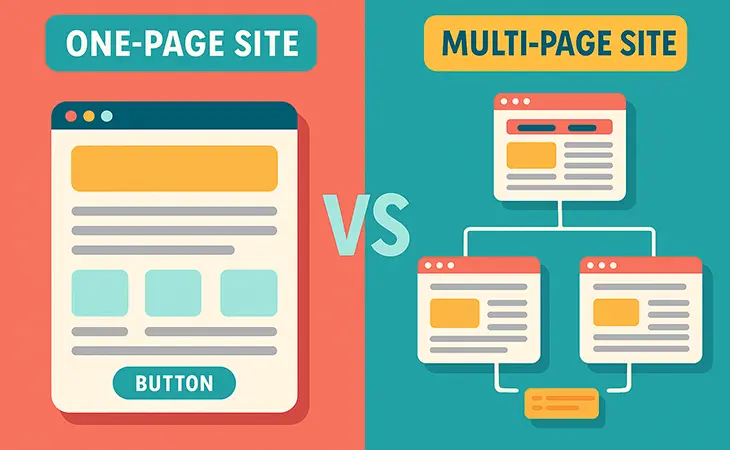
If you’ve been tempted by those “simple one-page sites” everyone pushes, I get it. They look clean, they’re cheap, they’re quick – but the one-page website disadvantage is real, and it’s a lot bigger than most business owners expect. We usually try to talk clients out of creating a one-page website.
Let’s break down why that “cute little site” might be the reason your phone isn’t ringing, your traffic is flat, and your SEO is basically taking a nap.
Phase 1 – What Is the One-Page Website Disadvantage?
A lot of small business owners think a single page is enough because they “don’t have much to say.”
But here’s the thing: Google doesn’t care how simple you want your site to be – Google cares about structure, content, and depth.
And that’s exactly where the one-page website disadvantage kicks in. These sites lack:
- Keyword depth
- Page hierarchy
- Internal links
- Dedicated service pages
- SEO relevance
- Lead capture space
It looks minimal… but it performs minimal too.
Phase 2 – SEO Problems You Can’t Ignore
Let’s hit you with the truth:
Google ranks pages, not just websites.
When you only have one page, you get one shot at ranking. That’s the biggest one-page website disadvantage you’ll face.
Here’s why they don’t rank well:
-
You can’t target more than one main keyword.
Want to rank for “roof repair,” “roof replacement,” and “insurance claims help”?
Not on a one-page site. -
No room for long-form content.
Google wants detail and authority – not 3 paragraphs and a button. -
No internal linking structure.
One-page sites can’t build SEO “silos,” so your authority stays weak. -
Low word count.
Most one-pagers barely hit 300-500 words.
Google wants 1,000-1,800+ for competitive searches.
The one-page website disadvantage is basically: you look pretty, but you don’t get found.
Phase 3 – Your Leads Suffer (Quietly)
Even if someone lands on your single-page site, they’re not staying long.
Here’s why:
-
You don’t have enough space to explain each service.
-
There’s no clear path for different customer types.
-
No room for trust signals like case studies or testimonials.
-
One CTA (usually at the bottom) = low conversions.
Real talk: not every visitor is ready to “Call Now.”
Some want to learn more. Compare. Browse. Build trust.
A core one-page website disadvantage is that it treats all visitors the same – and that kills conversions.
Phase 4 – Limited Growth Potential
Let’s say you start growing (congrats!).
Now you want to add:
- A blog
- A portfolio
- Multiple service pages
- Landing pages for ads
- City-specific SEO pages
- Lead magnets or resources
You know what happens?
You outgrow your entire site overnight.
A big one-page website disadvantage is that you can’t scale. You’ll have to rebuild from scratch, which costs more in the long run.
Phase 5 – Paid Ads Don’t Work Well on One-Page Sites
Running Google Ads or Facebook Ads?
Let me be blunt – one-page sites tank your ROI.
Why?
-
Your ad needs a dedicated landing page to match the search intent.
-
You need separate pages for each service to increase Quality Score.
-
Your one page tries to talk to everyone at once – bad for conversions.
The one-page website disadvantage becomes brutal with ads:
Lower relevance → higher CPC → fewer leads → wasted money.
Phase 6 – User Experience Suffers
Scrolling… scrolling… scrolling…
And then hitting a huge wall of mixed info in one long column?
Yeah, visitors bounce fast.
The one-page website disadvantage shows up in UX:
-
Harder to navigate
-
No clear sections
-
Too much content packed together
-
Users can’t skim to what they need
People don’t read long scrolling pages – they skim.
Without multiple pages, you kill skimability.
Final Thoughts
Bottom line, one-page sites aren’t “bad.” They’re just limited. And that limitation becomes expensive, fast.
If you want visibility, scalability, SEO power, and real lead generation, the one-page website disadvantage will hold you back every single time.
A multi-page site gives you:
- Dedicated service pages
- Stronger SEO
- Better user experience
- Higher conversions
- Space to grow
- Better ad performance
If you’re serious about growth in 2025, one page isn’t enough anymore.
It’s time to invest in a site that actually works – not just one that exists.
Further Reading
Explore more insights related to the one-page website disadvantage and how to improve small business website performance:
- Search Engine Journal – One-Page vs Multi-Page Websites: SEO Considerations
- HubSpot – Pros and Cons of Single-Page Website Design
- Rocket Web Designer – Why Your Cheap Website Design Is Costing You
[elementor-template id=”14586″]